 CodeMaster Academy
C vs C++: Key Differences Every Beginner Should Know
Introduction
C and C++ are two foundational programming languages that have shaped modern computing for decades. If you're studying computer science or engineering, you've almost certainly encountered both in your coursework, and it's natural to wonder exactly how they differ, given that C++ was literally built as an extension of C.
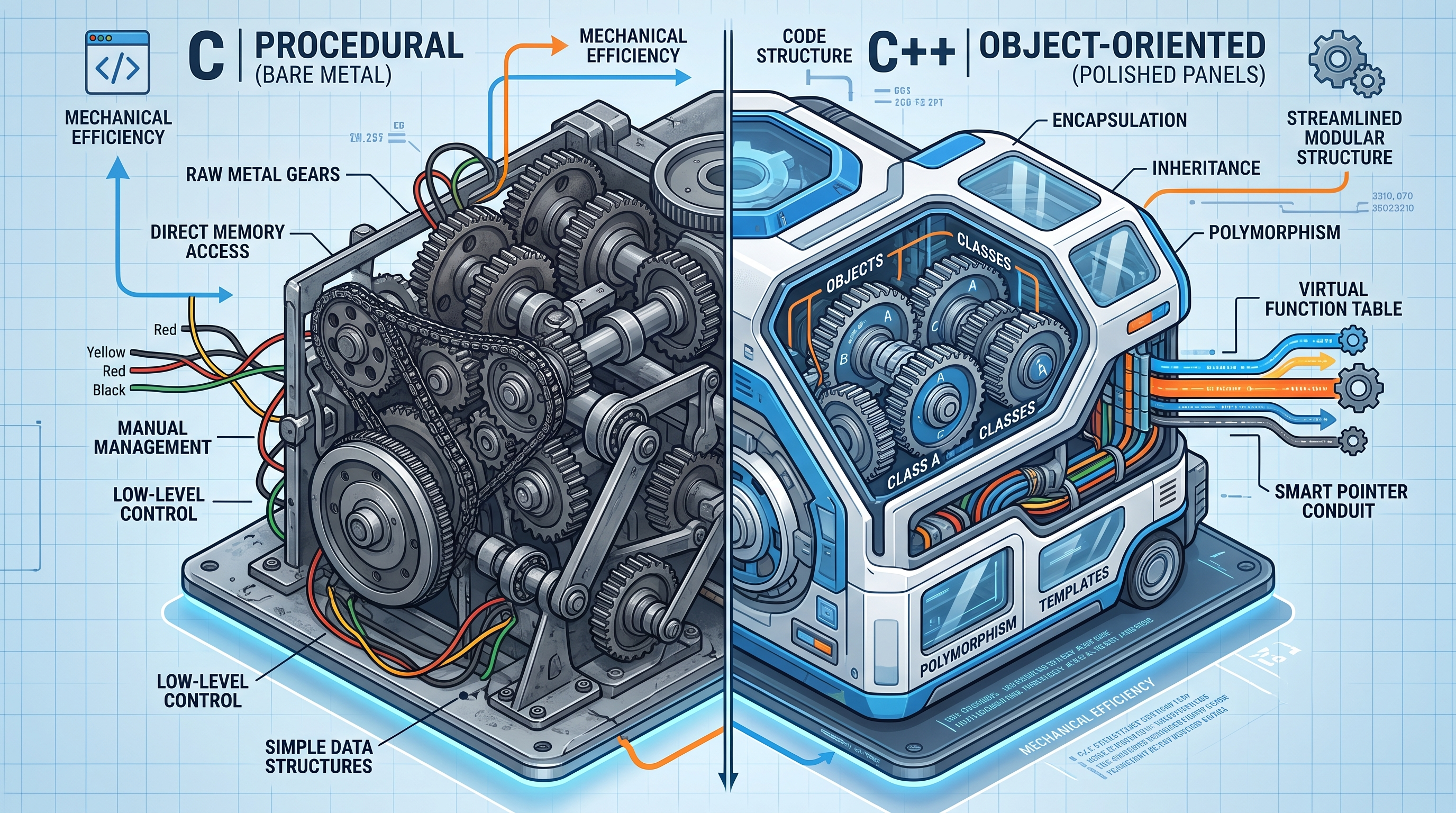
C, developed in the early 1970s, is a procedural programming language known for its simplicity, speed, and close relationship with computer hardware. It became the foundation for operating systems, embedded systems, and countless other languages that followed. C++, developed in the 1980s as an enhancement to C, introduced object-oriented programming concepts while retaining C's performance advantages and low-level control.
Many beginners assume C++ is simply a "better" or "newer" version of C, but the reality is more nuanced. Each language has distinct strengths, and the choice between them often depends on the specific project requirements, particularly around performance needs and code organization style.
This article breaks down the key differences between C and C++, covering syntax, programming paradigms, memory management, performance, and real-world use cases, so you can understand exactly when and why each language is used.
How to Use This Comparison
- Read the historical background section to understand why C++ was created.
- Review the programming paradigm differences to understand the biggest conceptual gap.
- Compare the syntax examples to see practical coding differences.
- Check the memory management section if you're concerned about performance and control.
- Explore the use cases section to see where each language is applied professionally.
- Try writing a simple program in both languages to feel the practical differences.
- Choose based on whether your project needs object-oriented structure or pure procedural simplicity.
Historical Background
C was created by Dennis Ritchie at Bell Labs in 1972, primarily to develop the Unix operating system. Its design emphasized efficiency, portability, and direct access to memory and hardware, making it ideal for systems programming. C quickly became one of the most influential languages in computing history, forming the foundation for countless other languages including C++, Java, and Python.
C++ was created by Bjarne Stroustrup in 1985 as "C with Classes," designed to add object-oriented programming capabilities to C while maintaining its performance and low-level capabilities. Over time, C++ evolved into a much more feature-rich language, incorporating templates, exception handling, and standard libraries that go far beyond what C offers.
Programming Paradigm: The Core Difference
The most fundamental difference between C and C++ lies in their programming paradigms. C is a purely procedural language, meaning code is organized around functions and procedures that operate on data sequentially. There is no built-in concept of classes or objects in C.
C++ supports both procedural and object-oriented programming, giving developers the flexibility to structure code around classes and objects when beneficial, while still allowing traditional procedural code when appropriate. This makes C++ a multi-paradigm language, offering significantly more flexibility in how large, complex projects are organized and structured.
Syntax Comparison
Here's a simple example demonstrating how C handles a basic structure using functions:
#include <stdio.h>

struct Car {
    char model[20];
    int year;
};

void displayCar(struct Car c) {
    printf("%s - %d\n", c.model, c.year);
}

int main() {
    struct Car myCar = {"Honda Civic", 2024};
    displayCar(myCar);
    return 0;
}
Here's the same concept implemented in C++ using a class:
#include <iostream>
using namespace std;

class Car {
public:
    string model;
    int year;

    void display() {
        cout << model << " - " << year << endl;
    }
};

int main() {
    Car myCar;
    myCar.model = "Honda Civic";
    myCar.year = 2024;
    myCar.display();
    return 0;
}
Notice how C++ bundles data (model, year) and behavior (display) together within a single class, while C separates data structures and functions entirely. This reflects the core object-oriented advantage that C++ brings to the table.
Memory Management
Both C and C++ give developers manual control over memory allocation, which is a major reason both languages remain popular for performance-critical applications. In C, memory is managed using functions like malloc() and free(). In C++, memory can be managed similarly, but it also introduces the new and delete operators, along with more modern tools like smart pointers that help prevent common memory leak issues.
This manual memory control, while powerful, requires careful handling in both languages. Mismanaging memory can lead to bugs like memory leaks or dangling pointers, which is why both languages demand a strong understanding of how memory works at a lower level compared to languages like Python or Java.
Direct Comparison Table
| Aspect | C | C++ |
|---|---|---|
| Paradigm | Procedural only | Procedural and object-oriented |
| Created | 1972 | 1985 |
| Data and functions | Separate | Can be bundled in classes |
| Standard Library | Smaller, more basic | Larger, includes STL (Standard Template Library) |
| Memory management | malloc/free | new/delete, smart pointers |
| Common use cases | Operating systems, embedded systems | Game engines, large applications, systems software |
| Learning curve | Simpler, fewer concepts | More complex due to OOP features |
Features
- C provides direct, low-level access to memory and hardware
- C++ supports classes, inheritance, and polymorphism for object-oriented design
- C++ includes the Standard Template Library (STL) for data structures and algorithms
- C is extremely lightweight, making it ideal for resource-constrained systems
- C++ supports function and operator overloading for more flexible code
- Both languages compile to highly efficient machine code
- C++ supports exception handling for more robust error management
- C's simplicity makes it easier to understand at a fundamental level
- C++ supports templates, allowing generic, reusable code structures
- Both languages offer extensive cross-platform compiler support
Benefits of Learning C
- Builds a strong foundational understanding of how computers work at a low level
- Teaches manual memory management, which strengthens overall programming discipline
- Provides a solid base for understanding how higher-level languages function internally
- Widely used in embedded systems, making it valuable for hardware-related careers
- Simpler syntax makes core programming logic easier to grasp initially
- Essential knowledge for operating systems and systems programming roles
- Highly portable across different hardware platforms and architectures
Benefits of Learning C++
- Combines low-level performance control with high-level object-oriented design
- Widely used in game development, including major game engines
- Provides access to the powerful Standard Template Library for efficient coding
- Strong demand in industries requiring high-performance software, like finance and gaming
- Offers more flexibility through multiple supported programming paradigms
- Builds a strong foundation for understanding other object-oriented languages
- Extensive use in competitive programming due to speed and STL support
Common Use Cases
- Building operating system kernels and low-level system software using C
- Developing embedded systems and firmware for hardware devices using C
- Creating high-performance video game engines using C++
- Building large-scale desktop applications using C++
- Developing device drivers that require direct hardware interaction using C
- Creating real-time trading systems in the finance industry using C++
- Building compilers and interpreters using C or C++
- Developing IoT devices and microcontroller firmware using C
- Creating graphics and rendering engines using C++
- Competitive programming and algorithm-heavy applications using C++
Frequently Asked Questions
1. Is C++ simply an upgraded version of C?
Not exactly. C++ was built as an extension of C, adding object-oriented features, but both languages continue to be developed and used independently for different purposes.
2. Which language should I learn first, C or C++?
Many educational programs teach C first to build foundational understanding, then move to C++ to introduce object-oriented concepts.
3. Is C++ backward compatible with C?
Mostly yes, though not entirely — most valid C code can be compiled with a C++ compiler, but there are some subtle differences and exceptions.
4. Which language is faster, C or C++?
Both offer comparable raw performance since C++ builds on C's efficient compilation model, though specific implementations can vary based on how features are used.
5. Is C still relevant today, or is it outdated?
C remains highly relevant, especially in embedded systems, operating systems, and performance-critical applications where its simplicity and speed are valuable.
6. What is the Standard Template Library (STL) in C++?
The STL is a powerful collection of pre-built data structures and algorithms in C++, including vectors, lists, maps, and sorting functions, that significantly speeds up development.
7. Do game developers use C or C++?
C++ is overwhelmingly preferred in game development due to its object-oriented features combined with high performance.
8. Is C++ harder to learn than C?
Generally yes, because C++ introduces additional concepts like classes, inheritance, and templates on top of everything C already requires.
9. Can I mix C and C++ code in the same project?
Yes, with proper configuration, C and C++ code can often be combined within the same project, which is common in many real-world systems.
10. Which language is better for a computer science student to master?
Both are valuable; mastering C builds strong fundamentals, while C++ prepares you for more complex, real-world object-oriented software development.
Compilation Process and Portability
Both C and C++ are compiled languages, meaning source code must be translated into machine code by a compiler before it can run, unlike interpreted languages such as Python that execute code line by line at runtime. This compilation step allows both languages to achieve significantly faster execution speeds, since the computer processes optimized machine instructions directly rather than interpreting instructions on the fly.
Portability is another important shared strength. Well-written C and C++ code can be compiled and run across different operating systems and hardware architectures with minimal changes, provided developers avoid platform-specific dependencies. This is one of the reasons both languages remain so popular for systems programming, where software often needs to run reliably across a wide variety of devices, from powerful servers to small embedded microcontrollers.
That said, C++ compilation tends to take noticeably longer than C compilation for large projects, primarily due to the additional complexity introduced by templates, classes, and the Standard Template Library. Developers working on very large C++ codebases often invest in build optimization tools and incremental compilation strategies to keep development cycles fast and efficient.
Which One Should You Learn First?
For students studying computer science or preparing for technical interviews, learning C first is often recommended because it strips away object-oriented complexity and forces you to understand fundamental concepts like pointers, memory addresses, and manual memory management directly. This foundational knowledge makes transitioning to C++, and even other object-oriented languages like Java or Python, considerably smoother later on.
However, if your primary goal is game development or building large-scale applications quickly, starting directly with C++ might make more practical sense, since you'll spend your learning time on skills directly applicable to your target career path. Many university computer science programs still teach C before C++ specifically because of the strong conceptual foundation it provides, even for students who will primarily work in C++ or other languages afterward.
Why Choose CodeMaster Academy?
CodeMaster Academy gives you access to free-forever tools with no registration required, letting you practice and experiment with both C and C++ directly in your browser. Our platform is fast, secure, and privacy focused, so you can code with confidence knowing your data stays protected. Designed to be mobile friendly and easy to use, CodeMaster Academy works smoothly whether you're studying on a desktop computer or reviewing concepts on your phone between classes. We're here to support students and self-learners as they build strong, foundational programming skills in languages like C and C++.
Last Updated: July 2026
Conclusion
C and C++ remain two of the most important languages in computing history, each offering unique strengths depending on your project's needs. C's simplicity and direct hardware access make it ideal for operating systems and embedded programming, while C++'s object-oriented capabilities and powerful standard library make it a preferred choice for game development, large-scale applications, and performance-critical software. Rather than viewing one as strictly superior, understand that both languages serve different purposes, and learning both will give you a deep, versatile foundation in systems-level programming that benefits you throughout your entire programming career.