 CodeMaster Academy
Python vs Java
Introduction
Python and Java are two of the most widely used programming languages in the world, and if you're a beginner deciding which one to learn first, you've probably encountered conflicting advice from different sources. Some say Python is easier and more beginner-friendly, while others argue Java's structure teaches better programming discipline. Both opinions have merit, and understanding the real differences between these languages will help you make an informed decision based on your specific goals.
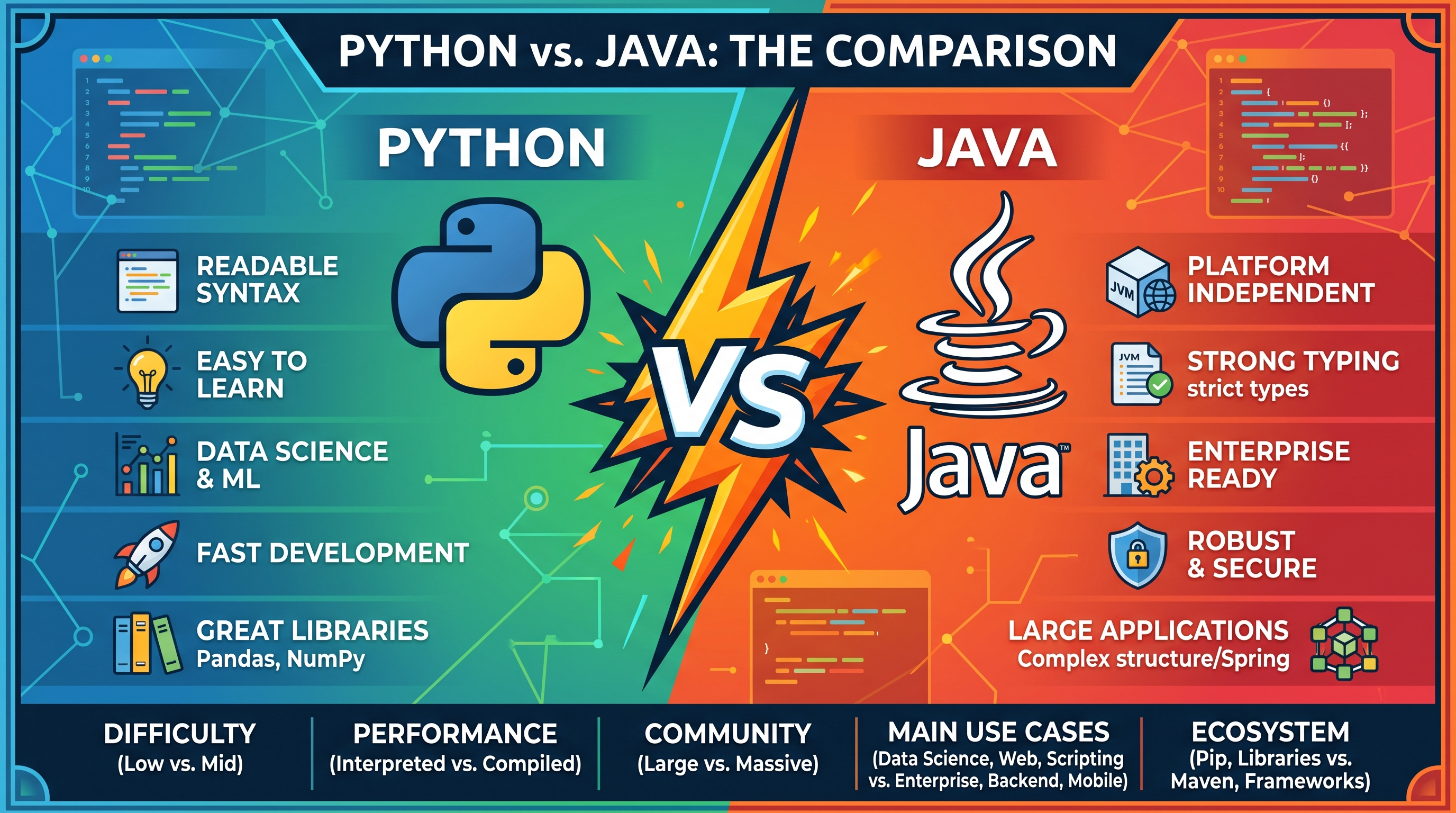
Python is known for its simple, readable syntax that closely resembles plain English, making it a favorite among beginners, data scientists, and automation engineers. Java, on the other hand, is known for its strict structure, strong performance, and widespread use in large enterprise systems, Android app development, and backend infrastructure.
Neither language is objectively "better" than the other — they excel in different areas and are often chosen based on the type of project being built. In this article, we'll compare Python and Java across syntax, performance, use cases, learning curve, and career opportunities so you can decide which one suits your needs, or understand both if you're already familiar with programming.
How to Use This Comparison
- Read the syntax comparison first to see how each language looks and feels.
- Review the performance and speed section if you're building performance-critical applications.
- Check the use cases section to see where each language is commonly applied in the real world.
- Consider the learning curve section if you're a complete beginner deciding where to start.
- Look at the career opportunities section if your decision is driven by job prospects.
- Try writing the same simple program in both languages to feel the difference firsthand.
- Make your decision based on your specific goals rather than general popularity alone.
Syntax Comparison
Python's syntax is famous for being clean, minimal, and beginner-friendly. It uses indentation to define code blocks instead of curly braces, which forces clean formatting naturally. Here's a simple "Hello World" example:
print("Hello, World!")Java, in contrast, requires more boilerplate code even for the simplest programs, because everything must exist within a class structure:
public class Main {
    public static void main(String[] args) {
        System.out.println("Hello, World!");
    }
}
This difference alone illustrates a core philosophy gap: Python prioritizes simplicity and readability, while Java prioritizes structure and explicitness, even at the cost of extra typing.
Performance and Speed
Java generally outperforms Python in raw execution speed because Java is a compiled language that runs on the Java Virtual Machine (JVM), which optimizes code execution efficiently. Python is an interpreted language, meaning it executes code line by line at runtime, which introduces additional overhead and generally makes it slower for computationally intensive tasks.
That said, Python's performance limitations are often mitigated through libraries like NumPy, which use optimized C code under the hood for heavy numerical computations. For most beginner and mid-level projects, the performance difference is not noticeable enough to matter significantly.
Use Cases: Where Each Language Shines
Python is dominant in data science, machine learning, artificial intelligence, automation scripting, and rapid prototyping. Its simple syntax allows developers to focus on logic and algorithms rather than fighting with complex code structures. Popular frameworks like Django and Flask also make Python a strong choice for web development.
Java is dominant in enterprise-level applications, Android app development, and large-scale backend systems where performance, scalability, and long-term maintainability are critical. Many banks, insurance companies, and large corporations rely heavily on Java for their core systems because of its stability and strong backward compatibility.
Learning Curve
For absolute beginners, Python is generally considered easier to learn due to its simple, readable syntax and minimal boilerplate code. New programmers can focus on understanding logic and problem-solving without getting bogged down by complex syntax rules.
Java has a steeper learning curve initially because it introduces concepts like classes, objects, and strict typing right from the start, even for the simplest programs. However, this structure can also teach beginners strong object-oriented programming discipline earlier in their learning journey, which can be valuable long-term.
Direct Comparison Table
| Aspect | Python | Java |
|---|---|---|
| Typing | Dynamically typed | Statically typed |
| Execution | Interpreted | Compiled (runs on JVM) |
| Syntax style | Minimal, indentation-based | Verbose, curly-brace based |
| Learning curve | Easier for beginners | Steeper due to OOP structure |
| Speed | Generally slower | Generally faster |
| Common use cases | Data science, AI, scripting, automation | Enterprise apps, Android, backend systems |
| Popular frameworks | Django, Flask, FastAPI | Spring, Hibernate, Android SDK |
Features
- Python supports dynamic typing, allowing flexible and fast development
- Java enforces static typing, catching many errors at compile time
- Python has an enormous ecosystem of data science and AI libraries
- Java has a massive presence in enterprise and Android development
- Python code is generally shorter and more readable than equivalent Java code
- Java's "write once, run anywhere" philosophy ensures strong cross-platform compatibility
- Python supports multiple programming paradigms, including functional and object-oriented
- Java's strong memory management and garbage collection improve application stability
- Python integrates easily with C/C++ for performance-critical operations
- Java has robust, mature frameworks like Spring for building large-scale applications
Benefits of Learning Python
- Faster development speed due to simple, concise syntax
- Huge community support and abundant learning resources
- Dominant position in data science, AI, and machine learning fields
- Great for beginners due to its gentle learning curve
- Versatile enough for web development, scripting, and automation
- Strong integration with popular data analysis and visualization tools
- Extensive standard library reducing the need for external dependencies
- Growing demand in emerging fields like AI and data engineering
Benefits of Learning Java
- Strong performance suitable for large-scale, resource-intensive applications
- Dominant language for native Android app development
- Excellent for building robust, secure enterprise-level systems
- Strong typing catches many bugs early, before runtime
- Backward compatibility ensures long-term stability for large codebases
- Vast ecosystem of enterprise frameworks like Spring and Hibernate
- High demand in corporate, banking, and government sectors
- Teaches strong object-oriented programming discipline early on
Common Use Cases
- Building machine learning models and AI systems using Python
- Developing native Android applications using Java
- Creating web applications using Python frameworks like Django or Flask
- Building large-scale banking and financial systems using Java
- Automating repetitive tasks and scripts using Python
- Developing enterprise resource planning (ERP) software using Java
- Performing data analysis and visualization using Python libraries
- Building scalable backend microservices using Java and Spring Boot
- Creating rapid prototypes and proof-of-concept applications using Python
- Developing government and insurance sector applications using Java
Frequently Asked Questions
1. Which language should a complete beginner learn first?
Python is generally recommended for complete beginners due to its simple, readable syntax and gentle learning curve.
2. Is Python or Java better for getting a job?
Both offer strong job opportunities, but the right choice depends on the industry — Python for data science and AI roles, Java for enterprise and Android development roles.
3. Can Python be used for Android app development?
While possible through certain frameworks, Java (and Kotlin) remain the standard and most widely supported languages for native Android development.
4. Is Java faster than Python?
Generally yes, Java tends to execute faster due to being a compiled language running on the optimized Java Virtual Machine.
5. Which language is better for web development?
Both are viable choices; Python offers frameworks like Django and Flask, while Java offers Spring, each suited to different project needs.
6. Do I need to learn both Python and Java eventually?
Not necessarily, but many professional developers do learn multiple languages over their careers to expand their opportunities and skill set.
7. Which language is used more in artificial intelligence?
Python is overwhelmingly the dominant language in artificial intelligence and machine learning due to its extensive library support.
8. Is Java harder to learn than Python?
Java generally has a steeper initial learning curve due to its stricter syntax and mandatory object-oriented structure.
9. Which language has better long-term career stability?
Both languages have strong long-term stability, as Python continues growing in AI/data fields while Java remains deeply embedded in enterprise systems.
10. Can I switch from Python to Java easily later?
Yes, once you understand core programming concepts in Python, transitioning to Java's syntax and structure becomes significantly easier.
Ecosystem and Community Support
Beyond syntax and performance, the surrounding ecosystem of libraries, tools, and community support plays a huge role in how enjoyable and productive it is to work with a language day to day. Python's community has built an enormous collection of open-source libraries covering nearly every domain imaginable, from web scraping and automation to deep learning and scientific computing. Tools like Jupyter Notebooks have also made Python especially popular in research and educational settings, where interactive, step-by-step code execution is valuable for exploring data and testing ideas.
Java's ecosystem, by contrast, has matured around enterprise-grade tooling and long-term stability. Build tools like Maven and Gradle, combined with powerful integrated development environments like IntelliJ IDEA and Eclipse, give Java developers robust support for managing large, complex codebases across big development teams. Java's strong backward compatibility also means companies can rely on codebases written a decade ago continuing to function reliably today, which is a major reason large financial institutions and government agencies remain heavily invested in Java-based systems.
Both communities are active, welcoming to newcomers, and offer extensive free learning resources, forums, and documentation. Whichever language you choose to start with, you'll find no shortage of support as you work through challenges and build your skills further.
Real-World Salary and Demand Considerations
Job market demand for both Python and Java remains consistently strong, though the specific roles differ. Python developers are heavily sought after in data science, machine learning engineering, automation, and increasingly in AI-related fields, where salaries can be quite competitive given the specialized nature of the work. Java developers remain in strong demand for backend engineering, Android development, and enterprise software roles, particularly at established corporations, banks, and government contractors that rely on Java's stability for mission-critical systems.
Rather than choosing a language purely based on salary data, which fluctuates by region and industry, it's often more effective to consider which type of work genuinely interests you, since sustained motivation and skill growth tend to matter more for long-term career success than small differences in average starting salaries between the two languages.
Why Choose CodeMaster Academy?
CodeMaster Academy provides free-forever tools with no registration required, making it easy to explore and practice both Python and Java directly in your browser. Our platform is fast, secure, and privacy focused, ensuring your code and data remain protected while you experiment and learn. Whether you're comparing syntax on a desktop or practicing on your mobile device, CodeMaster Academy remains mobile friendly and easy to use throughout your learning journey. We're committed to helping learners like you make informed decisions and build strong programming skills without unnecessary barriers.
Last Updated: July 2026
Conclusion
Choosing between Python and Java ultimately depends on your specific goals rather than which language is universally "better." If you're drawn to data science, artificial intelligence, or want the gentlest possible learning curve, Python is likely the better starting point. If you're interested in enterprise software, Android development, or want to build strong object-oriented programming discipline from the start, Java is an excellent choice. Many successful developers eventually learn both languages over their careers, using each where it excels most. Rather than worrying too much about making the "perfect" choice, focus on getting started, building real projects, and letting your interests guide your next steps.